OpEn on Raspberry Pi

Here we give an example of building a parametric optimizer in MATLAB, which will run on a Raspberry Pi. The parametric optimizer will listen for requests on a UDP socket. We will then establish a connection to the optimizer, remotely, and consume the service.
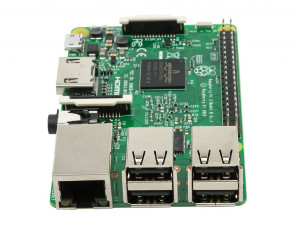
NOTE: Please, read the documentation of the MATLAB interface and the UDP communication protocol first.
In MATLAB, we run the following script:
nu = 6;                            % number of decision variables
np = 2;                            % number of parameters

u = casadi.SX.sym('u', nu);        % decision variables
p = casadi.SX.sym('p', np);        % parameters

phi = rosenbrock(u, p);            % cost function phi(u; p) (Rosenbrock)

constraints = OpEnConstraints.make_ball_at_origin(1.0);

build_config = open_build_config();
build_config.target = 'rpi';
build_config.build_mode = 'release';
build_config.udp_interface.bind_address = '0.0.0.0';
build_config.udp_interface.port = 3498;

open_generate_code(build_config, constraints, u, p, phi);
Note that we have specified that the target hardware is a raspberry pi, rpi (equivalently arm-unknown-linux-gnueabihf), the bind address is 0.0.0.0 (so that the service will bind on all valid IP addresses) and the port is 3498. We have also set the build_mode to release for maximum performance.
After we execute the script, the code generator will have created a new project at
build/autogenerated_optimizer/
We then copy the binary file from
build/autogenerated_optimizer/target/arm-unknown-linux-gnueabihf/release
onto our Raspberry Pi and execute it.
Then, on our PC (assuming we run on Linux), we run:
netcat -u {ip_address_of_raspberry} 3498
where {ip_address_of_raspberry} is the IP address (or domain name) of our Raspberry. This will start a console, where we can send data to the PI. For example, we write
{"parameter":[50, 100]}
and press Enter, to receive:
{
	"p" : [50.0, 100.0],
	"u" : [1.2597243950, 1.3938323941, 1.6995734606, 2.6752011118, 7.0289056698, 49.3661825375],
	"n" : 88,
	"f" : -5.243242641581731,
	"dt" : "1.207756ms"
}
So, what do you think? Let us know by providing some feedback (you can reach us live here).
If you like OpEn, please give it a star on github.
If you find a bug, please create an issue on on github.